WIDE UVA RANGE
Traditional nail lamps use fluorescent tubes and typically emit UVA over a relatively broad wavelength range.


TWO LIGHT SOURCE TECHNOLOGIES
Both techniques can produce light that cures gel products. The difference lies in the light source, the emitted spectrum, and the speed at which the appropriate nail product cures.
Traditional nail lamps use fluorescent tubes and typically emit UVA over a relatively broad wavelength range.
An LED nail lamp uses semiconductor diodes. Many models emit UVA, sometimes combined with visible violet light.
LED nail lamps can also emit UVA rays to cure gel products. With Handsome Skin, you protect your hands, while your nails and fingertips remain exposed for the treatment.
LIGHT SOURCE VERSUS SPECTRUM
The name on a lamp does not tell the whole story. For a proper assessment, the spectrum, intensity, curing time, and the exact model are the determining factors.
UV includes wavelengths that are shorter than those of visible light. According to the standard classification, UVA ranges from 315 to 400 nanometers.
UV includes wavelengths that are shorter than those of visible light. According to the standard classification, UVA ranges from 315 to 400 nanometers.
LED refers to the technology used to generate light. In itself, it does not indicate whether a lamp is UV-free.
LED refers to the technology used to generate light. In itself, it does not indicate whether a lamp is UV-free.
A light peak around 365 nm falls within UVA and occurs in various nail lamps.
A light peak around 365 nm falls within UVA and occurs in various nail lamps.
405 nm is just above the UV threshold and belongs to visible violet light. Some lamps combine this with UVA.
405 nm is just above the UV threshold and belongs to visible violet light. Some lamps combine this with UVA.
The transmitted wavelengths and intensity differ per device. Therefore, always check the exact model.
The transmitted wavelengths and intensity differ per device. Therefore, always check the exact model.
Curing time, number of rounds, hand position, and treatment frequency together determine the total exposure.
Curing time, number of rounds, hand position, and treatment frequency together determine the total exposure.
MORE THAN JUST THE TIMER
The set time tells only part of the story. The total amount of light depends on the device and the way it is used.
Which wavelengths the exact model emits.
How much light reaches the skin per unit of time.
How close the hands are to the light sources and how the light is distributed.
The number of curing cycles and how often treatments recur.
DURING THE TREATMENT
With gel polish and BIAB, a treatment often consists of multiple curing rounds. The hands are therefore placed close to the light source several times.
Put on the gloves before the treatment begins.
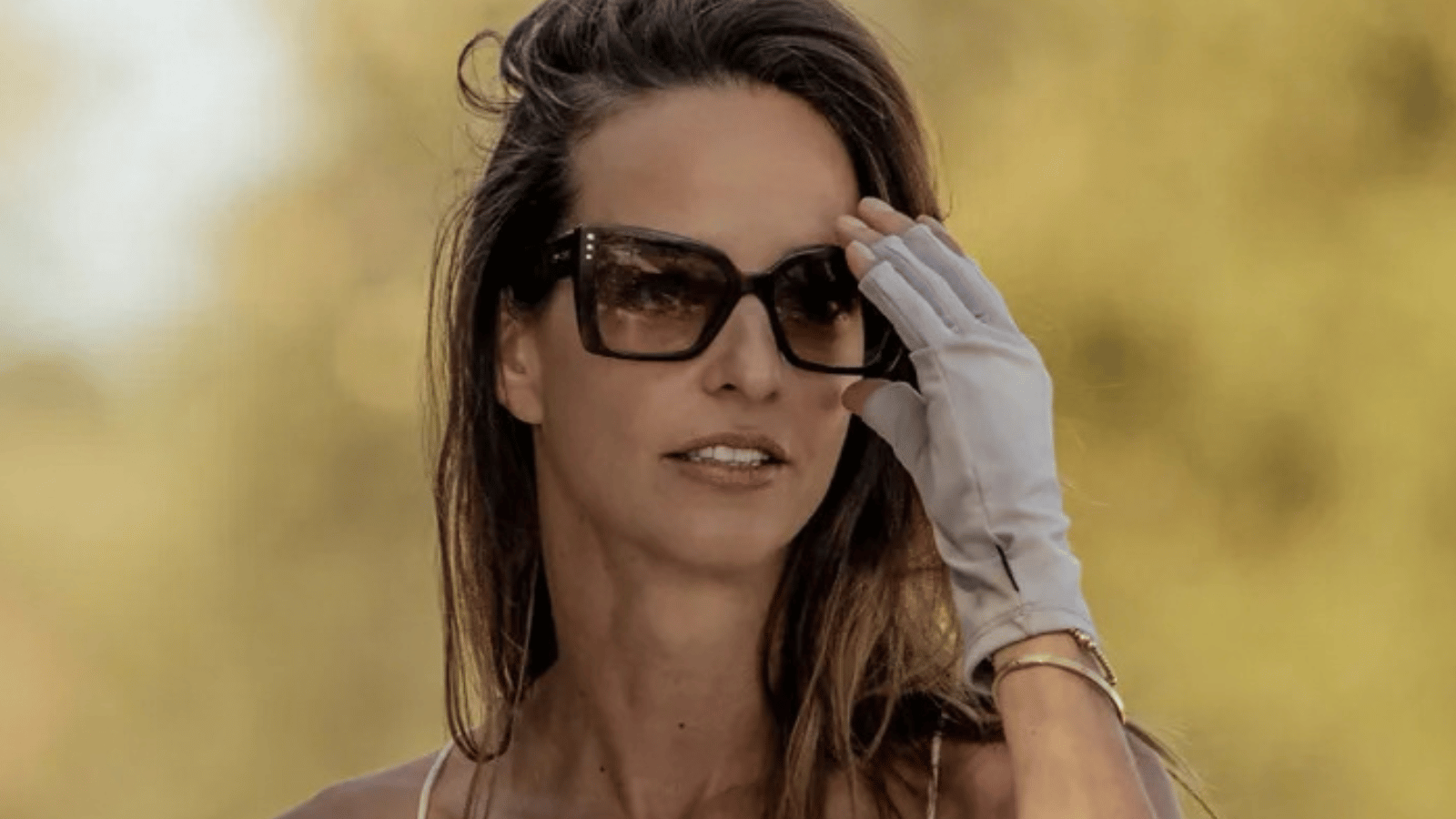
The gloves provide certified UPF 50+ protection for the hands during sessions under the lamp.
Nails and fingertips remain exposed for gel polish, BIAB and precision work. The gloves do not protect the exposed nails and fingertips.
THE SKIN OF THE HANDS
Your hands are in daily use, often uncovered and usually less consistently protected than your face. The skin on the back of the hand is relatively thin. As a result, changes in pigment, texture, and volume are more noticeable there.
The skin on the back of the hand is relatively thin and contains fewer sebaceous glands than the skin on the face. As volume and elasticity decrease, lines, tendons, and veins become more visible.
During daily activities, such as driving, cycling, and walking, and during manicures with a UV or LED lamp, the hands are exposed to UVA radiation. UVA contributes to pigment changes, loss of collagen, and visible skin aging.
Hands are used intensively and washed frequently. This repeated stress places a heavy burden on the skin barrier, making dryness and changes in skin texture more visible.

WHAT THE GLOVE DOES
No cream on the nails or salon equipment. No waiting time. But certified UPF 50+ protection for the hands.
LED IS THE SOURCE. WAVELENGTH DEFINES THE LIGHT.

IN THE SALON
With gel polish and BIAB, hands are often held close to the light source multiple times.

HAND PROTECTION
Open fingertips keep the nails accessible. The exposed parts are not protected.
CUSTOMER REVIEWS
All reviews for MY SHIELD and MY MINERAL, brought together in one place.
BEAUTIFUL NAILS. PROTECTED SKIN.
TWO COLLECTIONS, FIVE VERSIONS
Certified UPF 50+ protection for the hands, designed for everyday use.

MY SHIELD
Warm elegance with a powerful, protective feel.
€29,95

MY SHIELD
Cool, modern and designed for every day.
€29,95

MY SHIELD
Deep black with a powerful, timeless look.
€29,95

MY MINERAL
Soft lilac, barely perceptible and effortlessly refined.
€34,95

MY MINERAL
Timeless black for effortless protection with style.
€34,95
KNOW THE LAMP
Clear answers regarding light sources, wavelengths, curing, and protection.
No, not automatically. LED refers to the technology used to produce light. Many LED nail lamps emit UVA and sometimes combine this with visible violet light. The technical specifications of the exact model provide the best indication.
In the nail industry, the term UV lamp often refers to a fluorescent lamp with a relatively broad UVA range. An LED lamp uses LED chips and usually operates with more targeted light peaks. Both types can emit UVA.
No. According to the standard classification, UVA runs up to 400 nm. Light at 405 nm falls just above that and belongs to visible violet light.
No. Measured spectra and intensities vary by brand, model, light source, and position within the lamp. Therefore, a label saying UV or LED alone is insufficient to indicate the exposure.
No. A device can be used according to the instructions and still emit UVA. Safe use and UV-free are different concepts.
Wavelength, intensity, distance, hand position, duration per round, number of rounds, and treatment frequency together determine how much radiant energy reaches the skin.
Research shows that nail lamps can emit UVA and that the dose varies significantly per device. The available data do not show a convincing direct causal link between normal use and skin cancer in humans. Long-term data are still limited.
Follow the recommended combination of lamp and nail product, adhere to the prescribed curing time, and avoid unnecessary extra rounds. The American Academy of Dermatology also mentions water-resistant broad-spectrum sunscreen with an SPF of 30 or higher, or dark, opaque, fingerless gloves as options.
READ MORE
Delve into UVA, skin aging, nail lamps, and verifiable UPF protection.
PULL ON FOR PROTECTION
Two collections, five versions, and one direct solution: daily protection for your hands.
Handsome Skin structurally donates €1 per pair sold to the Dutch Cancer Society (KWF).